
Tekniska data
| Formel | C13H13N3OS |
||||||
| Molekylvikt | 259.33 | CAS-nr. | 4311-88-0 | ||||
| Löslighet (25°C)* | In vitro | DMSO | 52 mg/mL (200.51 mM) | ||||
| Water | Insoluble | ||||||
| Ethanol | Insoluble | ||||||
| In Vivo (Tillsätt lösningsmedel till produkten individuellt och i ordning.) |
|
||||||
|
* <1 mg/ml betyder svårlösligt eller olösligt. * Vänligen notera att Selleck testar lösligheten för alla förbindelser internt, och den faktiska lösligheten kan skilja sig något från publicerade värden. Detta är normalt och beror på små variationer mellan olika partier. * Rumstempererad frakt (Stabilitetstester visar att denna produkt kan fraktas utan några kylåtgärder.) |
|||||||
Beredning av stamlösningar
Biologisk aktivitet
| Beskrivning | Necrostatin-1 (Nec-1) är en specifik RIP1 (RIPK1)-hämmare och hämmar TNF-α-inducerad nekroptos med ett EC50 på 490 nM i 293T-celler. Necrostatin-1 blockerar också IDO och undertrycker autophagy och apoptosis. | ||||
|---|---|---|---|---|---|
| Mål |
|
||||
| In vitro | Necrostatin-1 (1-100 μM) inhibits the autophosphorylation of overexpressed and endogenous RIP1.It is found RIP1 is the primary cellular target responsible for the antinecroptosis activity of this compound. This chemical efficiently suppresses necroptotic cell death triggered by an array of stimuli in a variety of cell types. It, previously identified as small-molecule inhibitor of necroptosis, inhibits RIP kinase-induced necroptosis and inhibits TNF-α-induced necroptosis in jurkat cells with EC50 of 490 nM. |
||||
| In Vivo | Necrostatin-1 (Nec-1) is a specific small molecule inhibitor of receptor-interacting protein kinase 1 (RIPK1) that specifically inhibits phosphorylation of this compound. |
||||
| Egenskaper | Ett kraftfullt verktyg för att karakterisera rollen av necroptosis med karakteriserat primärt mål. |
Protokoll (från referens)
| Kinasanalys: |
|
|---|---|
| Cellanalys: |
|
| Djurstudie: |
|
Referenser
|
Kundvalidering av produkt
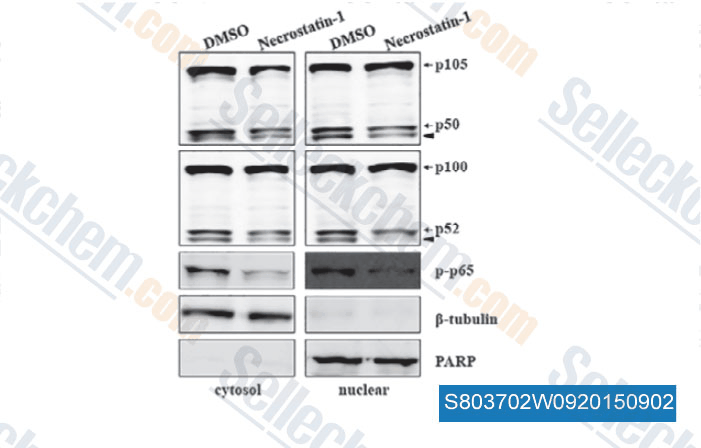
-
Data från [ , , J Cell Mol Med, 2015, 19(5): 1042-54 ]
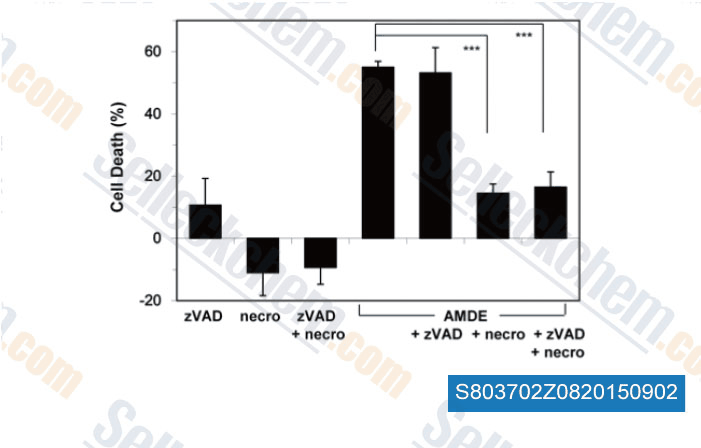
-
Data från [ , , PLoS One, 2015, 10(3): e0122083 ]
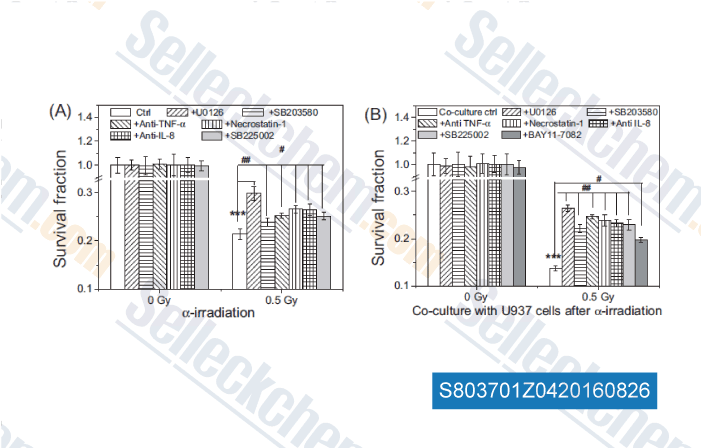
-
Data från [ , , Mutation Research, 2016, 789:1-8. ]
Sellecks Necrostatin-1 (Nec-1) Har citerats av 329 Publikationer
| Peroxisome-derived and liver-specific hydroxyacid oxidase 1-mediated hydrogen peroxide promotes ferroptosis by augmenting peroxisomal ROS [ J Adv Res, 2026, S2090-1232(26)00342-5] | PubMed: 41990971 |
| Opposing roles of DGAT-mediated lipid droplet biogenesis in the regulation of ferroptosis sensitivity [ FEBS J, 2026, 10.1111/febs.70467] | PubMed: 41729026 |
| Andrographolide-induced PANoptosis underlies its multiple organ toxicity in mice [ Toxicol Appl Pharmacol, 2026, 507:117682] | PubMed: 41371369 |
| Soluble tissue factor generated by necroptosis-triggered shedding is responsible for thrombosis [ Cell Res, 2025, 10.1038/s41422-025-01167-8] | PubMed: 40940518 |
| The noncanonical function of liver-type phosphofructokinase potentiates the efficacy of HDAC inhibitors in cancer [ Signal Transduct Target Ther, 2025, 10(1):341] | PubMed: 41083431 |
| LINE-1 ORF1p Mimics Viral Innate Immune Evasion Mechanisms in Pancreatic Ductal Adenocarcinoma [ Cancer Discov, 2025, 10.1158/2159-8290.CD-24-1317] | PubMed: 39919290 |
| AAK1 activation-mediated iron trafficking drives ferroptotic cell death [ Nat Commun, 2025, 17(1):819] | PubMed: 41407700 |
| Ferroptosis-activating metabolite acrolein antagonizes necroptosis and anti-cancer therapeutics [ Nat Commun, 2025, 16(1):4919] | PubMed: 40425585 |
| Harnessing the FGFR2/NF2/YAP signaling-dependent necroptosis to develop an FGFR2/IL-8 dual blockade therapeutic strategy [ Nat Commun, 2025, 16(1):4128] | PubMed: 40319089 |
| Targeting pancreatic cancer glutamine dependency confers vulnerability to GPX4-dependent ferroptosis [ Cell Rep Med, 2025, 6(2):101928] | PubMed: 39879992 |
RETURPOLICY
Selleck Chemicals villkorslösa returpolicy säkerställer en smidig online-shoppingupplevelse för våra kunder. Om du på något sätt är missnöjd med ditt köp kan du returnera artikeln/artiklarna inom 7 dagar efter mottagandet. I händelse av produktkvalitetsproblem, antingen protokollrelaterade eller produktrelaterade problem, kan du returnera artikeln/artiklarna inom 365 dagar från det ursprungliga köpdatumet. Vänligen följ instruktionerna nedan vid retur av produkter.
FRAKT OCH FÖRVARING
Sellecks produkter transporteras i rumstemperatur. Om du tar emot produkten i rumstemperatur kan du vara trygg; Sellecks kvalitetskontrollavdelning har utfört experiment för att verifiera att placering i normal temperatur under en månad inte påverkar den biologiska aktiviteten hos pulverprodukter. Efter insamling ska produkten förvaras i enlighet med de krav som beskrivs i databladet. De flesta av Sellecks produkter är stabila under de rekommenderade förhållandena.
EJ AVSEDD FÖR ANVÄNDNING PÅ MÄNNISKOR, INOM VETERINÄRDIAGNOSTIK ELLER FÖR TERAPEUTISKT BRUK.